Hey there, Josh Brown here.
I spend most of my time behind the scenes, not on job sites. But when the same mistake shows up over and over across our investor base, it’s worth pulling on the thread.
Here’s one that costs people real money: they run a full gut rehab cost estimate through the exact same formula they’d use on a paint-and-carpet flip. The numbers come out wrong before they’ve even bought the house.
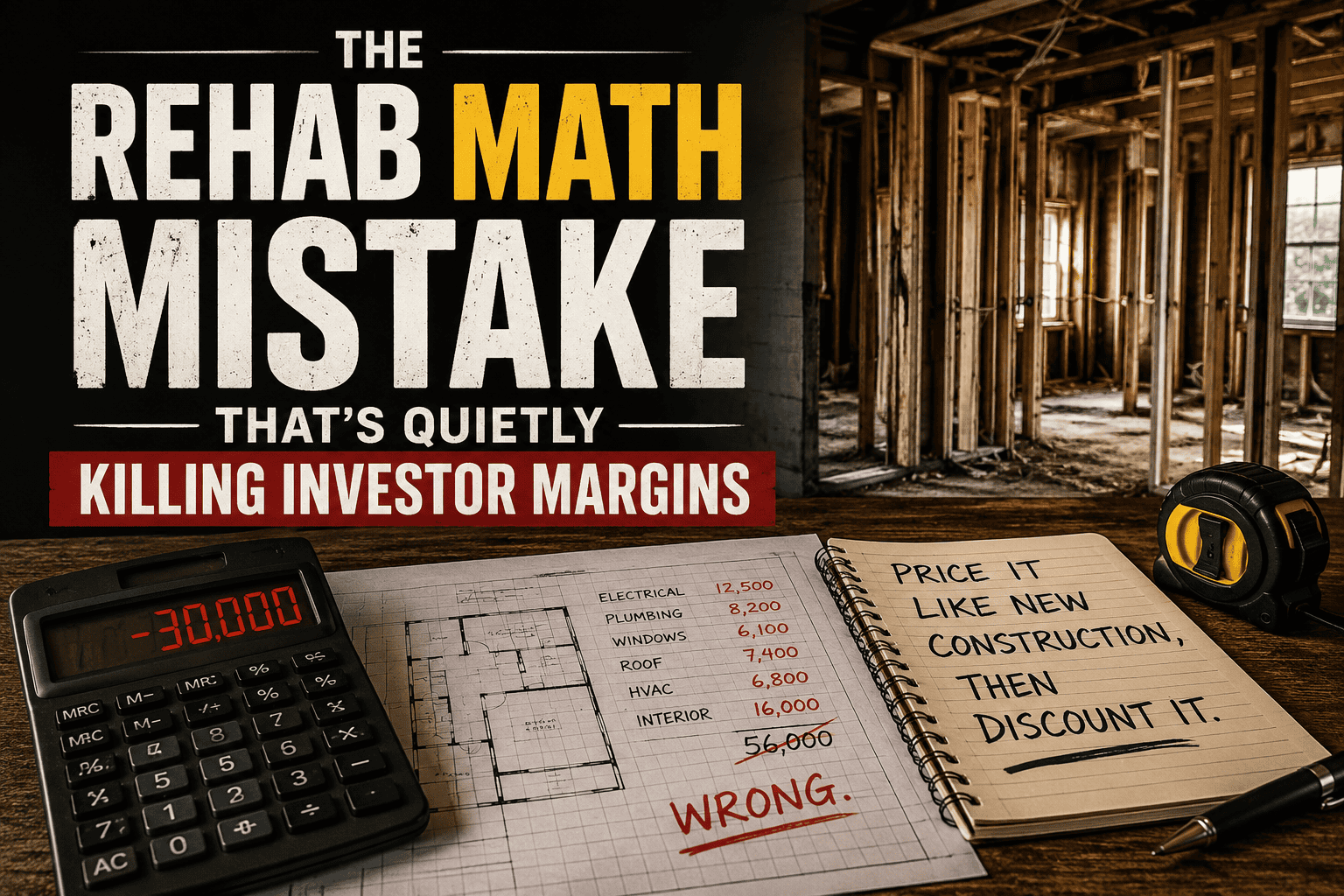
I saw it again recently in a deal one of our students brought to a coaching call. Small ranch, under twelve hundred square feet, needed everything: electrical, plumbing, windows, roof, furnace, right down to the studs. He ran it through a standard repair estimator, landed on a number in the high fifty thousands, and something felt off. It should have. The number was low by twenty to thirty thousand dollars.
That gap isn’t a rounding error. It’s a systems problem, and it’s worth understanding if you’re serious about scaling past your first few deals.
Full Gut Rehab Cost Estimate: Ditch the Template
Most repair estimators give you three buckets. Light, medium, heavy. Light means paint and carpet, maybe a kitchen refresh. Medium adds a roof and HVAC. Heavy stacks on siding and windows.
That system works fine for ninety percent of deals. It falls apart on the other ten percent, the full gut jobs where a house gets stripped to its bones and rebuilt from the inside out. At that point you’re not doing an aggressive version of a normal rehab. You’re building new construction inside an old shell.
Different category, different math, and pretending otherwise is exactly how investors end up upside down on a deal they thought they understood.
This is a pattern I’d flag for anyone running a business off of standardized formulas, real estate or otherwise. Templates are a great starting point. They’re a bad ending point. The investors who plateau are usually the ones who never learn when to set the template aside and actually think through a deal.

The Better Anchor: Price It Like New Construction, Then Discount It
Here’s the fix, and it’s simple once you see it.
Find out what new construction actually costs per square foot in your market right now. Discount that number twenty to thirty percent, because a gut rehab still keeps the foundation and the exterior walls instead of building them from zero.
That’s your real number. Not fifty dollars a square foot pulled from a generic “heavy” bucket. Depending on your market, it might land at a hundred dollars a square foot, or a hundred fifty. Either way, it’ll be a lot closer to what the job actually costs than a one-size-fits-all estimator will ever get you.
This isn’t theory. I’ve watched our mentors run this exact math live on coaching calls, comparing a current bathroom gut to local new-build costs per foot, and the numbers hold up every time. It’s a simple exercise, and it’s the one step most investors skip.
The Upside Nobody Prices In
Here’s the part that gets missed even more often than the cost side, and it should change how you feel about taking on a heavy rehab in the first place.
When you gut a house down to the studs and rebuild every system, you reset its effective age to zero. New thirty-year roof, new HVAC, new electrical and plumbing. To a buyer, that house behaves like it was built yesterday, even with old bones underneath.
Buyers pay for that. Expect at least a ten percent premium over a typical comp in the same condition class, sometimes more depending on the market. Nobody buying that house has to think about a roof or an HVAC system for a very long time, and that peace of mind has a price tag. Most investors never build it into their after repair value. They should.
If your comps say a house like this is worth a hundred thirty-five thousand in average condition, don’t stop there. A full rebuild might genuinely be worth ten to fifteen percent more, because every major system in it just got a fresh clock.
Why This Matters Beyond One Deal
I could stop at “get your rehab math right.” But the bigger point is about how you build a business that scales. The investors who stay stuck doing one deal at a time are usually the ones running every deal through the same default assumptions, no matter how far outside the norm the deal actually is. The ones who grow are the ones who notice when a deal has left the template behind and are willing to do the extra ten minutes of math.
That’s a business lesson, not just a rehab lesson. Consistency beats randomness, but only if your system is built to flex when the input changes.
Find the Deals Worth Doing This Math On
None of this matters if you’re not finding motivated sellers with real deals to run the numbers on in the first place. The Real Estate Data Feed surfaces pre-foreclosures, tax delinquencies, and other motivated seller leads across the country, so you’ve got something worth pulling out a calculator for. There’s a 100% risk-free test drive if you want to see what’s sitting in your market right now.
Get the rehab math right before you lock in an offer.
It’s a small habit that separates investors who scale from investors who stall.
Stay Sharp,
Josh Brown