On last week’s Dealmaker webinar, Cam told the group something nice about me. He said I don’t just teach consistency, I live it.
He’s right, but not for the reason you might think.
I’m not more disciplined than you, and I don’t have superhuman willpower. Years ago I stopped relying on willpower.
I built a machine instead, and the machine does the follow-up whether I feel like it or not. That machine is a real estate follow-up system.
That’s the part most investors miss about the seven touch rule. So let’s fix that today.
Build a Real Estate Follow-Up System (7 Touches)
A motivated seller may need to see or hear from you as many as seven times before they respond.
Not because your message was bad. Because they weren’t ready. They’re working through denial, anger, bargaining, depression, and acceptance. Somewhere in that journey, they become ready. Your job is to still be there when it happens.
Meanwhile, every other investor pinged them once and vanished. So when the seller finally looks up, there’s one name they recognize. Yours.
That’s the whole concept. Simple. Almost nobody does it.
Willpower Is a Terrible Marketing Plan
Here’s the pattern I’ve watched for fifteen years.
An investor launches a campaign. Direct mail, texting, cold outreach, whatever.
They send touch one. A few responses, no deals.
They send touch two. Crickets.
Then life happens. They get busy. They get discouraged.
The campaign quietly dies at touch two, and they conclude the marketing “didn’t work.”
The marketing never got a chance to work. Industry data backs this up: roughly 80% of sales take five or more follow-ups, and 44% of sales people quit after one. In wholesaling, the majority of closed deals come from leads that ignored the first three attempts.
The problem was never the channel. The problem was asking your own discipline to carry a 90-day sequence. Discipline has a bad week. A machine doesn’t.
What a Seven-Touch Machine Looks Like
Building a follow-up machine is not complicated. Here’s a skeleton of one you could use:
- Pick the list once. Pull sellers with stacked motivations. Pre-foreclosure plus vacant. Absentee plus tax delinquent. Quality in, quality out. Use this free trial to get your best motivated seller list now!
- Write all seven touches before you send the first one. If touch five doesn’t exist yet, you will never send it. Trust me on this.
- Spread them across channels. Mail piece, text, phone call, voicemail, then repeat the rotation. Same name, different doors.
- Put every touch on a schedule. Day 1, 7, 14, 30, 45, 60, 90. Your CRM or even a calendar fires the next touch. Not your memory. Not your mood.
- Keep the message consistent. You found them through your research, you buy houses in the area, you can help. That’s it. Never mention what you know about their situation.
Notice what’s missing: motivation. The machine doesn’t need you to feel like following up on a Tuesday. It just runs.
Steal These Seven Touches
Don’t start from a blank page. Here’s a sequence you can lift word for word and load into your system today.
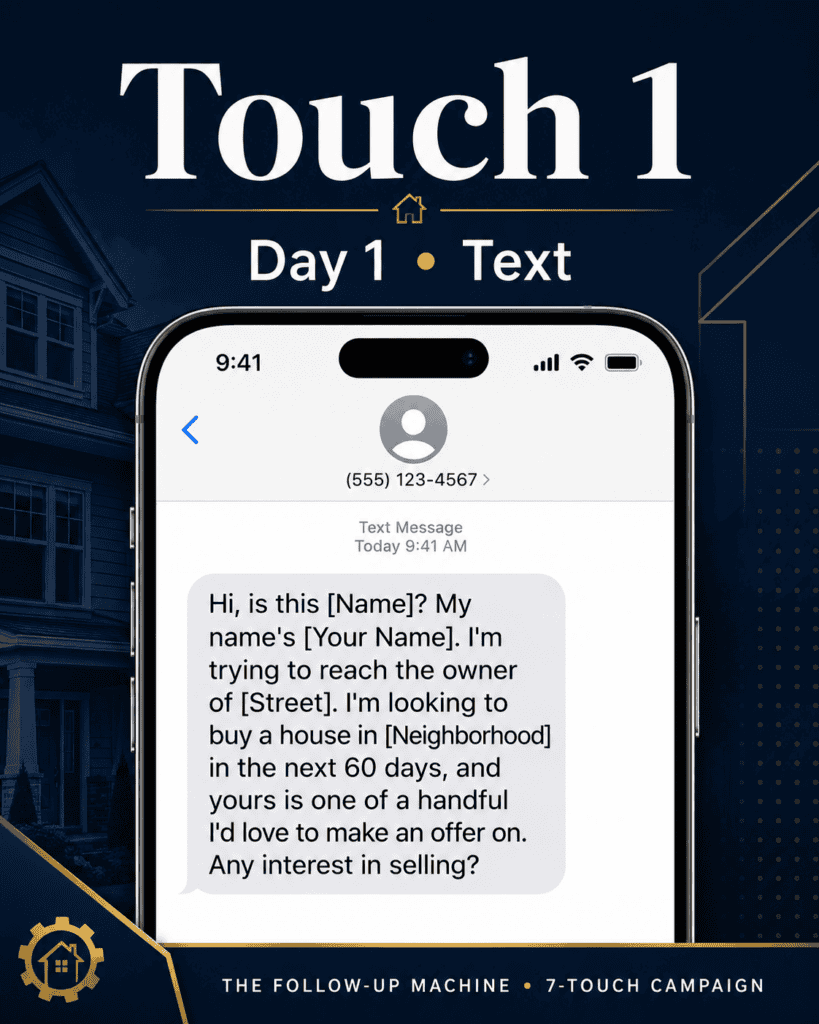
Touch 1, Day 1 (text): “Hi, is this [Name]? My name’s [Your Name]. I’m trying to reach the owner of [Street]. I’m looking to buy a house in [Neighborhood] in the next 60 days, and yours is one of a handful I’d love to make an offer on. Any interest in selling?”
Why it works: a question about identity almost forces a reply, and “one of a handful” makes it feel chosen, not blasted.
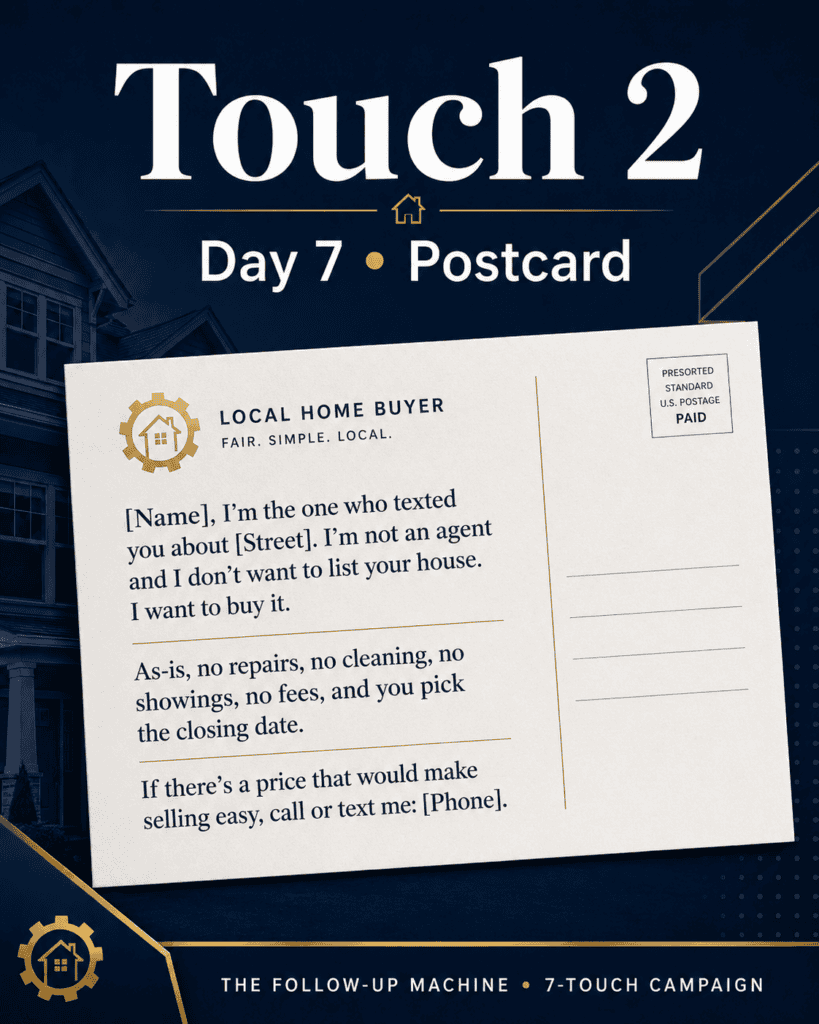
Touch 2, Day 7 (postcard): “[Name], I’m the one who texted you about [Street]. I’m not an agent and I don’t want to list your house. I want to buy it. As-is, no repairs, no cleaning, no showings, no fees, and you pick the closing date. If there’s a price that would make selling easy, call or text me: [Phone].”
Why it works: “I’m the one who texted you” links the touches together. That’s recognition, the whole point of seven touches.
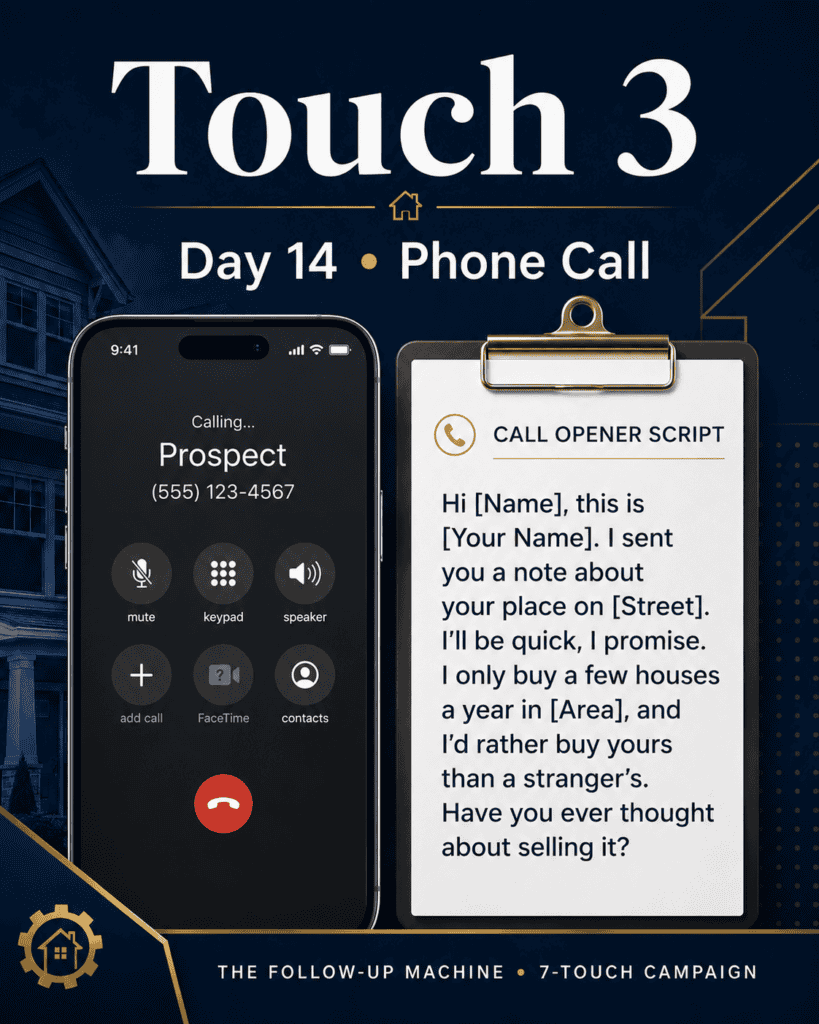
Touch 3, Day 14 (phone call opener): “Hi [Name], this is [Your Name]. I sent you a note about your place on [Street]. I’ll be quick, I promise. I only buy a few houses a year in [Area], and I’d rather buy yours than a stranger’s. Have you ever thought about selling it?” Then stop talking and let them answer.
Why it works: permission to be brief lowers their guard, and the open question hands them the floor. Silence does the selling.
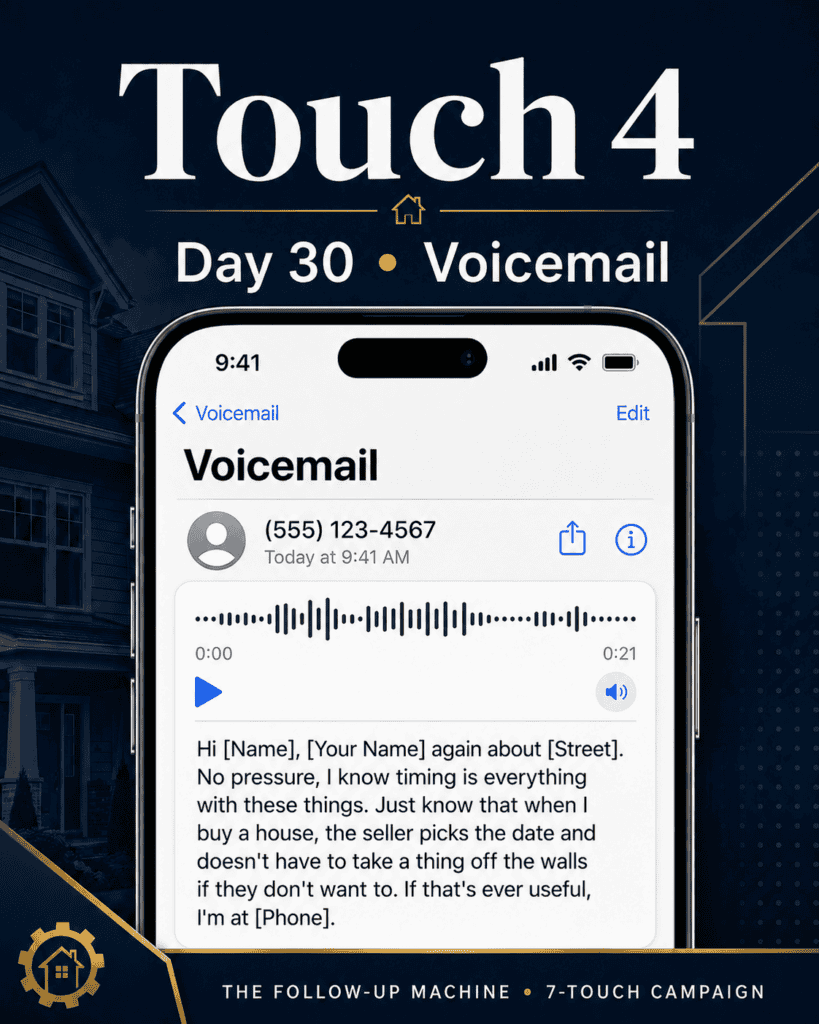
Touch 4, Day 30 (voicemail, under 20 seconds): “Hi [Name], [Your Name] again about [Street]. No pressure, I know timing is everything with these things. Just know that when I buy a house, the seller picks the date and doesn’t have to take a thing off the walls if they don’t want to. If that’s ever useful, I’m at [Phone].”
Why it works: “timing is everything” tells a not-ready seller you’ll still be there when they are. And “nothing off the walls” paints a picture “as-is” never will.
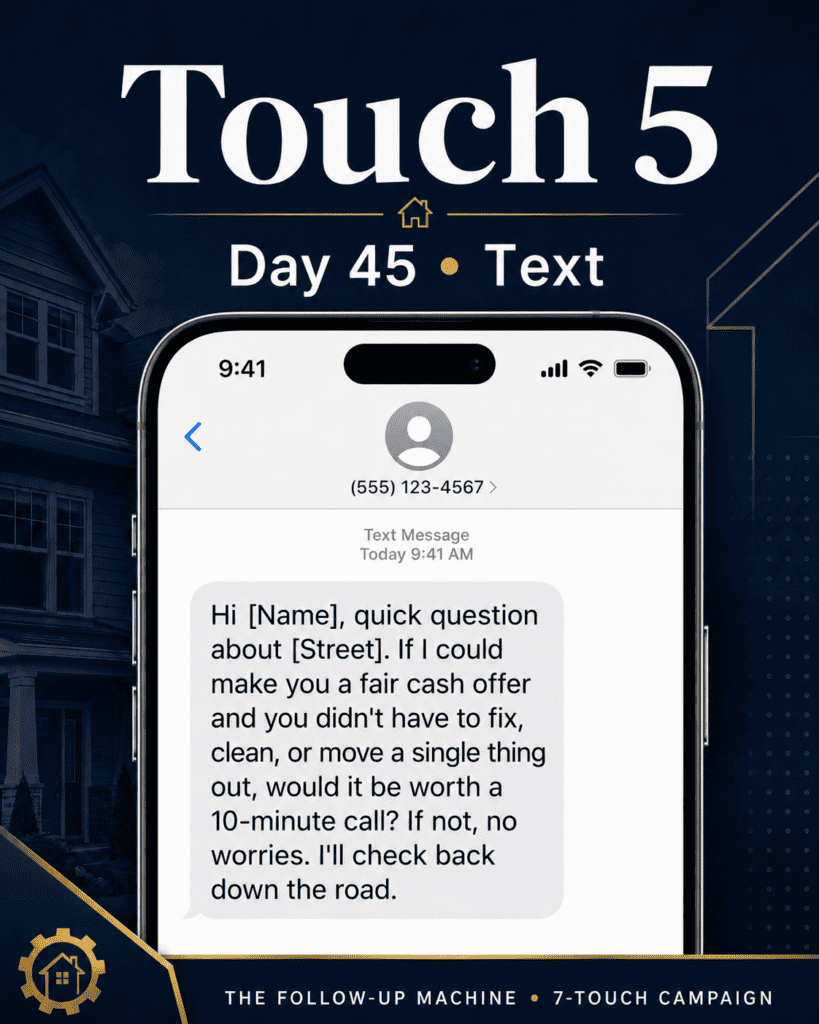
Touch 5, Day 45 (text): “Hi [Name], quick question about [Street]. If I could make you a fair cash offer and you didn’t have to fix, clean, or move a single thing out, would it be worth a 10-minute call? If not, no worries. I’ll check back down the road.”
Why it works: you’re not asking them to sell a house. You’re asking for 10 minutes. Small yes first.
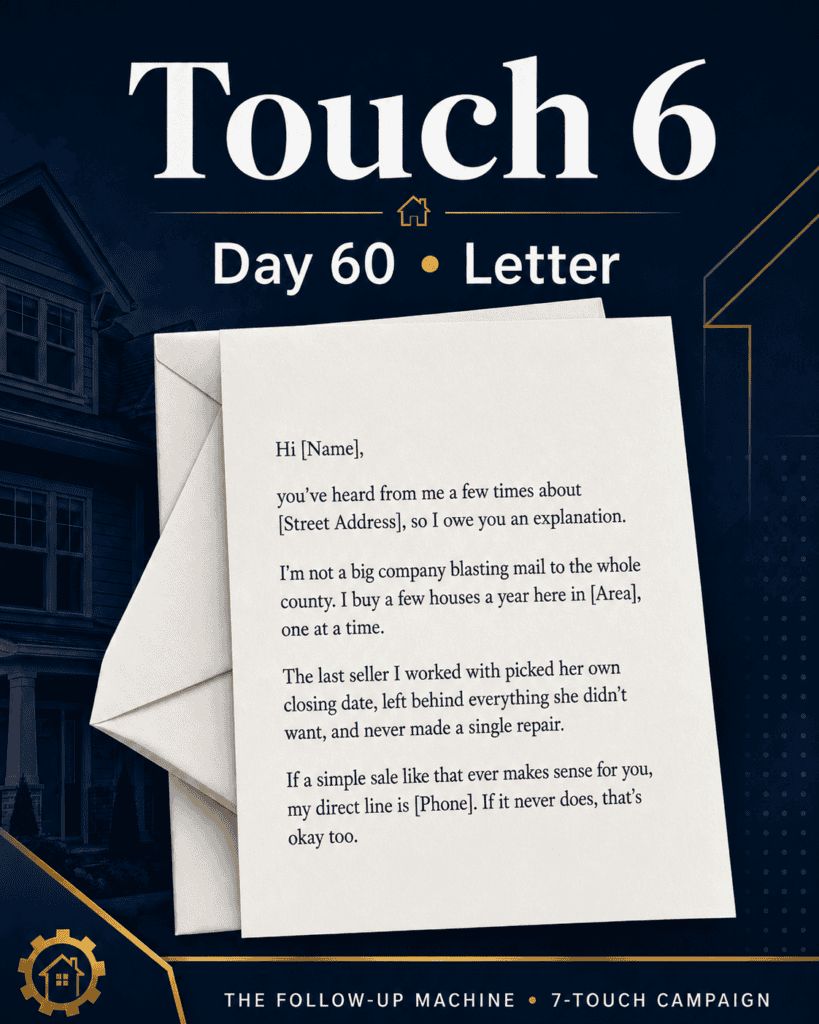
Touch 6, Day 60 (letter): “Hi [Name], you’ve heard from me a few times about [Street Address], so I owe you an explanation. I’m not a big company blasting mail to the whole county. I buy a few houses a year here in [Area], one at a time. The last seller I worked with picked her own closing date, left behind everything she didn’t want, and never made a single repair. If a simple sale like that ever makes sense for you, my direct line is [Phone]. If it never does, that’s okay too.”
Why it works: story and proof instead of a pitch. This is the letter that sits on the fridge until the day they’re ready.
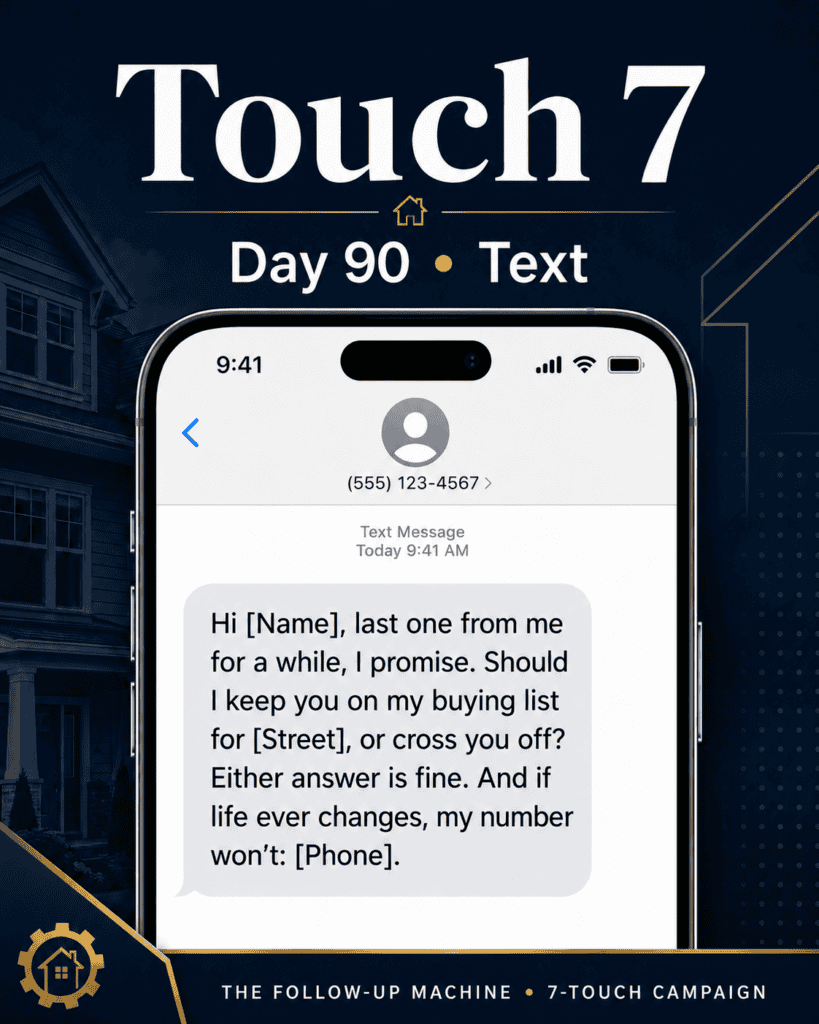
Touch 7, Day 90 (text): “Hi [Name], last one from me for a while, I promise. Should I keep you on my buying list for [Street], or cross you off? Either answer is fine. And if life ever changes, my number won’t: [Phone].”
Why it works: the “breakup close”. “Cross you off” pulls replies out of people who ignored the first six, because nobody likes a door closing.
One adjustment before you load this up: the clock belongs to the seller’s situation, not to you. For most lists, 90 days is perfect. But if you’re working pre-foreclosures in a fast state, or the data shows a sale date, compress the whole sequence to land before that date. Same seven touches, run on days 1, 5, 10, 16, 23, 31, and 40. The deal can expire before your sequence does. Don’t let it.
Now notice what none of these messages say. Nothing about a foreclosure. Nothing about the house being vacant or the taxes being behind. You found them through your research, you buy in the area, you can help. The more you know about a seller’s situation, the more important it is to keep it to yourself.
And the name never changes. Seven touches from one person builds recognition. Seven touches from seven angles builds nothing.
The Machine Wins Because It Doesn’t Have Feelings
Touch two silence doesn’t discourage a sequence. It can’t get discouraged. It sends touch three.
And that matters because of when sellers actually respond. A pre-foreclosure seller in denial isn’t ignoring you personally. They’re frozen. Weeks later the sale date is closer, the pressure is real, and now they’re ready to talk. If your system quit at touch two, someone else gets that call.
I hear a version of the same confession all the time, and often from investors with twenty-plus years in the business: “I’ve done well, but I’ve never found a predictable way to generate motivated sellers.”
The channel isn’t the problem.
The market isn’t the problem.
The missing ingredient is almost always consistency. And my advice is one step past that. Don’t try to be consistent. Build something that is consistent for you, then feed it.
Consistency creates consistency. But systems create consistency you don’t have to sweat for.
Feed the Machine and Get Out of the Way
A follow-up machine is only as good as the list you feed it. The Real Estate Data Feed gives you motivated sellers nationwide, with the stacked motivations that make seven touches worth sending. There’s a 100% risk-free test drive, so you can pull your first list today.
Build the sequence once. Feed it good data. Let it run.
Then do what the machine can’t do: talk to the sellers who respond, and make offers. Because the more offers you make, the more money you make. And when one goes under contract, here’s how to sell a wholesale deal fast.
Stay Sharp,
Josh Brown
Thank you so much for sharing this system with us. This so helpful. It gives the concrete steps and map to follow for the predictable results we are all searching for. Thanks again.
You bet John!! Enjoy 🙂
I love this, Josh!!! So awesome!! Nadine Hunt
Awesome Nadine, I am glad you found it it helpful!