Hey there, Cam Dunlap here.
I’m sitting here finishing up a bathroom remodel on the other side of the wall next to my home office — literally, the plumber just left — and it’s got me thinking about one of the most expensive mistakes I see wholesalers make over and over again.
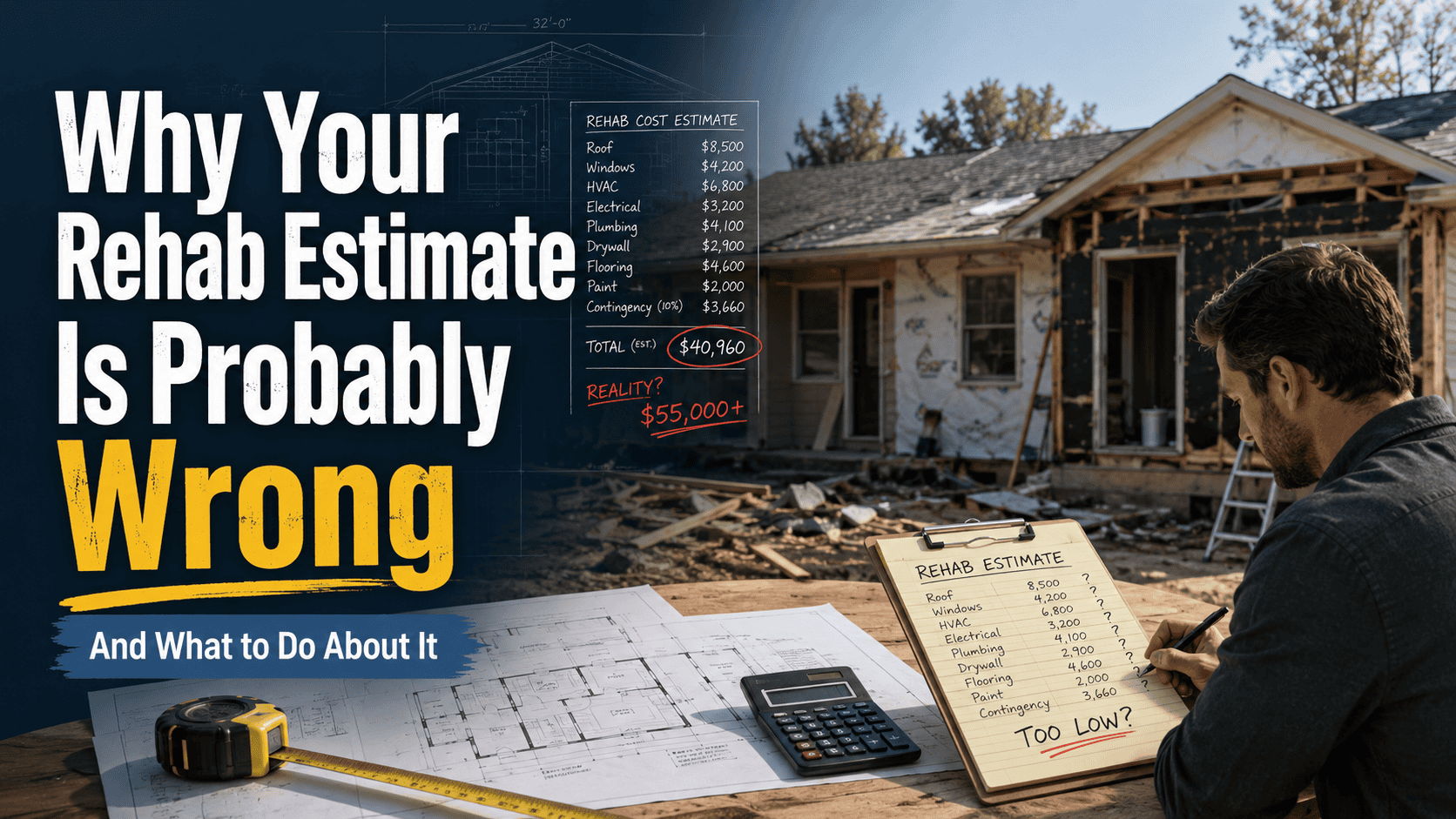
They misprice repairs. Their per square foot rehab estimate looks tidy—and it’s still wrong.
And it costs them the deal, their credibility with buyers, or both.
I had a question come in recently from one of our members — I’ll call him Alex. He was looking at a four-bedroom ranch in Flint, Michigan. 1,152 sq feet on a crawl space. The house needs a complete gut: electrical, plumbing, windows, insulation, roof, HVAC. Everything but the foundation. He ran it through the repair estimator at $50 a square foot, got a number around $57,600, and said, “This seems way low. I’m thinking more like $75,000 to $80,000.”
Alex was right to question it.
And his instinct was right on the number. But the conversation opened up something that I think every wholesaler needs to hear.
Your Per-Square-Foot Estimator Wasn’t Built for This
The square-footage repair categories — bad, really bad, awful — were never designed for a total gut job. Light, medium, and heavy rehab covers your typical range: paint and carpet, kitchen, bathrooms, maybe a new roof or HVAC, maybe both. When you start talking about ripping a house down to the studs and floor joists and rebuilding everything inside the shell, you’ve gone somewhere those categories don’t cover.
So stop trying to force it.
When a house needs that level of work, the better lens is this: what would it cost to build this thing new, minus the land and the shell?
Take your market’s new construction cost per square foot. Discount it 20 to 30 percent for the foundation and the exterior walls and whatever else you’re keeping. That’s your number. It’s not going to be $57,000. It might be $75,000. It might be much more.
On Alex’s deal, even $80,000 could be low. The only way to know is to think through it clearly.
The Entry-Level House Trap
Here’s where a lot of people get tripped up — and I’ll be honest, I watched myself almost fall into a version of this recently.
We’re doing a bathroom remodel here at my place that is somewhere north of $50,000 and we gutted it to the studs including the floor. It’s big, at right about 250 square feet. The math gets us to over $200 per square foot for that bathroom alone. And it is a nice bathroom, but this is not a $135,000 house.
When you’re estimating repairs on an entry-level house, you cannot let the cost of work in a premium home bleed into your thinking. The materials, fixtures, and finishes are all different.
The whole frame of reference is different.
An $80,000 complete gut on an eleven-hundred-square-foot entry-level ranch in Flint is a completely different project than an $80,000 remodel project in a waterfront property in Florida. Same dollar amount. Completely different scope and quality. You have to hold those two things apart in your mind, or you will misprice the deal.
Premium You’re Leaving on the Table
Here’s the flip side — and this one actually works in your favor.
When your buyer does a total rehab on a house, they reset the effective age of every major system to zero. New roof with a 30-year life. New HVAC. New electrical. New kitchen and baths. From a buyer’s perspective, that house functions like a brand-new house.
And brand-new houses sell at a premium.
How much of a premium? Depends on the market, but I’d start at ten percent over your typical comparable sales and go from there. So if Alex’s ARV is $135,000, he should be pressure-testing whether that number accounts for the fact that his rehabber buyer is going to deliver something closer to new construction than a standard resale.
If it’s really more like $150,000 when you account for that premium, the deal math changes. Maybe his five-grand wholesale fee becomes eight or ten or more. Worth checking before you walk away from money.
Get It Under Contract First. Do Your Homework Second.
Here’s what I told Alex, and I mean it: if the seller wants $15,000, owes $10,000 in back taxes, and needs $3,000 cash at closing — get that thing under contract today.
The numbers look right. The motivation is real. The deal is probably there.
What you don’t do is spend two weeks agonizing over repair estimates before you tie it up. Get it under contract, use your inspection period to do your real homework, and then confirm your numbers. You can walk if the numbers don’t work. But you can’t get the deal back after someone else takes it.
And here’s a move that more wholesalers should make: once you wholesale it to a rehabber, stay in touch with that buyer. Ask if you can swing by and see the project. Watch how they actually approach a gut job. You’ll learn more from one walk-through than from reading three books about rehab estimation.
That’s how you develop the eye for it. Not theory. Walking through houses that are being rebuilt, asking questions, and noticing what your assumptions got right and what they missed.
The Real Value of Ugly Deals
A house like this — total gut, entry-level, modest market — is exactly the right deal for a new wholesaler to start learning on. Not to rehab yourself. That would be learning to swim in the deep end of the pool. But to wholesale, watch, and learn.
Your buyer takes all the rehab risk. You make your fee. And then you have the opportunity to observe a complete renovation from a safe distance, at no cost to you, and build the instincts that will make you better at this for the rest of your career.
Ugly deals are some of the best teachers in this business. Don’t avoid them. Just price them right and use them to learn from.
When you’re ready to go find deals like this one, the Real Estate Data Feed is where I’d start. It gives you access to motivated seller lists, distressed property data, and cash buyer contacts all in one place — everything you need to find the Alexes of the world and get them under contract. There’s a 7-day free trial so you can see what’s available in your market right now.
Get in there. Start looking at deals.
The ugly ones might be the most instructive ones you ever find.
Regards,
Cam Dunlap
You are right. You need to estimate rehab cost. We rehabbed a home a couple years ago and let a realtor convince us what it would take to make the house a home. She also indicated the ARV. The rehab cost a bit more. We also took her advice on what we should offer which was more than what the MAO indication was. We made a little but not as much as we had hoped for. Tough lesson to learn. Same realtor brought a prospect that has an ARV between $400k to $450k. It was an REO and was going to require a lot of work. Before I could work up an offer the listing agent updated the listing indicating offers needed to be made by the next day. I called my agent and she did not know about the time line. List price was $225,000 and sold as is. All utilities were turned off so could not verify plumbing, electrical or water was good. Based on that I told my agent my off would have bee$152k. Her thought was that was too low. She thought $175-$180k. Lesson learned is do my own calculations. I would rather be low and maybe negotiate a little higher.