
Hey there.
We talk to a lot of investors who come to us saying they’re not doing deals. And when we ask what they’ve been doing and how it’s been working, they look at us and say: “uhhhhh…I don’t know”.
That’s the whole problem.
If you’re not doing deals and you don’t have data, nobody can help you. Because without numbers, all anyone can tell you is “do more marketing” — which is the least useful advice in the world. But when you have the real estate wholesaling metrics laid out in front of you, you can find exactly where deals are getting lost. And you can fix that one thing.
Here’s the framework we teach.
The Funnel Every Wholesaler Needs to Track
Think of your business as a funnel with five stages. Each one feeds the next.
Unique prospects — How many brand new people are you reaching out to each month? These are people you’ve never contacted before.
Total contacts — How many total times did you reach out to your marketing list this month? If you have 500 people on your list and you hit each of them three times, that’s 1,500 contacts. Tracking both numbers matters because you need to know volume AND reach.
Leads — How many of those contacts responded and said “tell me more”? This is not a committed seller. It’s someone who raised their hand. Divide your leads by your total contacts and you get your response rate. That tells you how well your marketing message is landing.
Offers — Of the leads you spoke with, how many did you actually make an offer to? Make verbal offers to every qualified lead. Not a letter of intent, not a written offer — a verbal offer, so there’s room to negotiate. If you’re not getting to an offer, that’s your choke point.
Deals — How many of those offers turned into contracts? Divide deals by offers and you get your conversion rate.
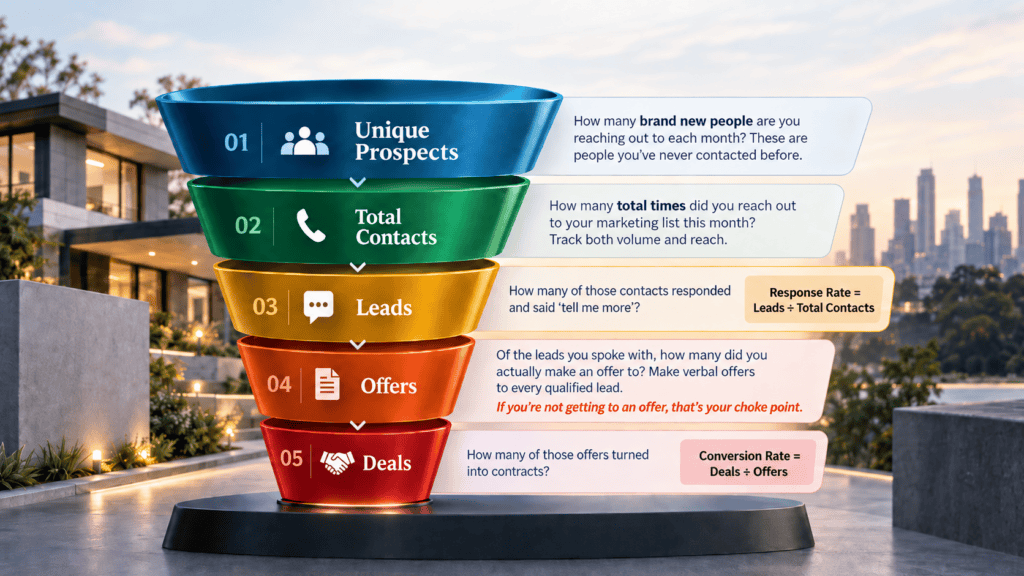
Most investors who aren’t doing deals have the problem in one of two places: either they’re not generating enough leads, or they’re not converting the leads they have. The metrics show you which one it is. And those two problems have completely different fixes.
What Your Conversion Rate Is Actually Telling You
A 1 to 5 percent lead-to-deal conversion rate is common in this business. If you’re below that, you’re either getting the wrong kinds of leads, or your offer conversations need work — and those are very different problems.
Wrong leads means your marketing is reaching people who aren’t motivated. The fix is upstream: your list, your channel, your targeting.
Low conversion means motivated sellers are coming in but you’re not getting to a deal. That’s a skills issue — how you’re pre-qualifying, how you’re presenting offers, how you’re handling objections. That’s fixable with practice and feedback, but you have to know that’s where the problem is.
One investor we worked with ran a Yellow Pages ad that brought in fifty to sixty calls a month. Looked great on paper. But when he tracked the numbers, not a single one of those calls turned into a deal. Every caller wanted full retail price because the ad was in the real estate agent section — people looking to list their home, not sell it at a discount. He burned a full year’s budget before tracking revealed the problem. Without the numbers, he’d have kept going.
Cost Per Lead and Cost Per Deal
Once you have your funnel numbers, you can get to the two financial metrics that actually drive your business decisions.
Cost per lead: Take everything you spent on a specific marketing channel that month — mail pieces, data, software, whatever — and divide it by the number of leads that came from it. Now you know what you’re paying for each opportunity.
Cost per deal: Take your total marketing spend and divide it by the number of deals closed. Now you know what a deal actually costs you.
Once you know your cost per deal, you can set a real budget. If a deal costs you $2,500 and you want four deals a month, you need to be spending $10,000 in marketing. That’s a business plan. That’s predictable. Compare that to “I spent some money and got a couple deals” — which is how most investors operate.
This is a science, not a guessing game. When you work the numbers, the results get better over time. Costs come down, revenue goes up.
If You’re Using a VA for Cold Calling, Track These Too
If you have a virtual assistant making calls, add these to your tracking:
- Hours worked per week
- Total calls per week
- Average calls per paid hour
- Leads generated from those calls
- Their conversion rate (calls to leads)
If you have more than one VA, this becomes even more valuable. Because when one VA is consistently outperforming another, you don’t fire the underperformer — you listen to what the better one is doing and teach it. Best practices spread when you have the numbers to identify them.
Start Tracking Now, Even If You’re Not Doing Deals
If you’re not yet doing deals, you especially need to track this. Because if you don’t know what’s happening in your business, nobody can tell you what to fix. Everyone’s working blind.
Whatever you’re doing — cold calling, texting, direct mail, driving for dollars — write down the numbers every week. How many people did you contact? How many came back? How many did you talk to? How many offers did you make?
That data is your roadmap out of wherever you’re stuck.
And it all starts with a clean prospect list. The quality of your data at the top of that funnel determines everything downstream. The Real Estate Data Feed is where our investors pull motivated seller data — pre-foreclosures, absentee owners, stacked motivations — updated regularly and searchable by market. There’s a 7-day free trial if you want to see what’s available where you’re working.
Know your numbers. Work the science. The deals will follow.
Stay Sharp.
Josh Brown